SHSU APR mark steady in 2012-13
5/14/2014 5:00:00 PM | Athletics
The NCAA released it's annual Academic Progress Rate on Wednesday and the average mark for Sam Houston State has remained steady from last year.
The department had an average APR of 966 for the 2012-13 athletic season, which was identical to the mark from 2011-12. The department had a 964 average APR in 2010-11. Also, for the third straight year, Sam Houston State will not face any penalties.
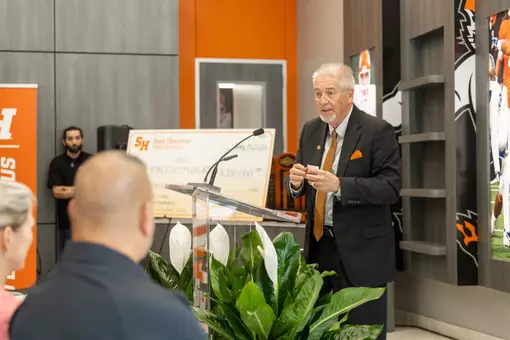
“The APR is something we closely monitor as a department and I'm happy to see we continue to post strong marks across the board,” director of athletics Bobby Williams said. “While this measurement is now in its 10th year, it is something we continually have had to learn and adjust to.”
Eight of the sports increased their APR numbers from last season, with three sports getting a double-digit boost in their APR. Women's cross country had the largest increase, going from 972 to 986.
Every Division I sports team calculates its APR each academic year. Scholarship student-athletes each semester receive one point for remaining eligible and one point for staying in school or graduating. Teams scoring below certain thresholds can face consequences, including practice restrictions and playing season reductions. Rates are an average of the past four years' performance. National aggregates are based on all teams with usable data at the time of analysis.
In order to compete in the 2014-15 postseason, teams must achieve either a 930 multi-year APR (increased from 925 during the first nine years of APR measuring) or a 940 average over the most recent two years. This approach represents the next step in a phased-in move to a standard 930 benchmark, which will be in place for most schools with next year's announcement of 2013-14 data collected in the fall of 2014.
Three sports, men's basketball (930), football (931) and men's golf (933) are close to the cutoff mark, and Williams said the coaches have worked hard to keep their teams postseason eligible.
“Something we have stressed as a department, is the focus on the type of student athlete we want to recruit to Sam Houston,” Williams said. “Especially for the sports that are close to that 930 number, we have to be sure every athlete we are bringing in can remain a student at this university both athletically and academically.”
The sport with the biggest historical improvement has been women's basketball. After posting a mark of 907 in 2007-08 and receiving a reduction in scholarships, the program received and APR score of 981 this year.
Baseball, which received a score of 905 in 2006-07 and faced scholarship penalties for three years, had another good mark of 948 and for the third-straight year has been comfortably above the penalty cutoff mark.
“In the last four years, our sports that have had penalties in the past have been showing improvement,” Williams said. “So much of the APR is about athlete retention as much as it is about grades, and that has been an area where we have seen a dramatic improvement.”
The NCAA provides APR adjustments for student-athletes who transfer to another four-year school after earning a 2.6 grade-point average and those who leave in good academic standing for professional athletics careers. The most recent APRs are multi-year rates based on the rates from the 2009-10, 2010-11, 2011-12 and 2012-13 academic years.
In 2014-15, 36 teams will be ineligible for the postseason due to their low APR, compared with 13 teams last year. The increase is not unexpected, as this is the first year that teams are required to achieve a 930 APR – or average a 940 over the last two years – to be eligible to compete after the regular season. Also, 57 Division I teams will take penalties – separate from the postseason requirement – for not meeting the minimum academic standard set by member schools.