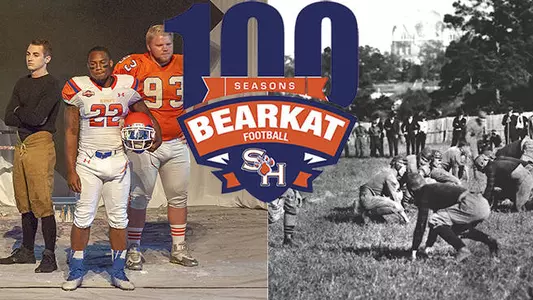
Times have changed since football's first year
8/5/2015 5:57:00 PM | Football
With preseason training camp for the 2015 Sam Houston football underway, the 100th season of Bearkat football has officially started.
During the next three months the defending Southland Conference champs will strive to add more glory to the history of Sam Houston football that began more than a century ago.
 |
| Century Season Micro Site |
| Enjoy 100th season video, historical photographs, "Then & Now" notes and other history features |
While the first intercollegiate sport played in Huntsville was baseball (in 1906), once football started the only events that kept the Kats off the gridiron were World Wars.
In 1911, students played an intramural football game on the baseball field built on a cotton patch east of campus. The facility was named Pritchett Field honoring Joseph Pritchett, dean of men at Sam Houston and brother of the late school principal.
A year later, those players approached biology professor S. R. Warner, a new arrival in Huntsville, to be their coach. Warner, who played football at William and Mary, agreed to supervise the squad for a four-game schedule.
Late in October, in the inaugural game for both schools, Sam Houston hosted what was described by an observer as a “pugnacious” Rice team. Spectators stood shoulder to shoulder along the lime-lined boundary that marked off the converted gridiron.
A game account reported Len Baldwin took a snap at the five and "ploughed his way through the center of the line" in the first half to score Sam Houston's first touchdown. But Rice fought to earn a 20-6 victory before climbing aboard a train and heading back to Houston.
Sam Houston bounced back to defeat Bryan Baptist Academic 27-6 and Blinn Memorial College 18-6 before ending with a 19-7 loss to Lon Morris College. All four games were played in Huntsville.
Football has been a continuous sport since at Sam Houston except for the war years -- 1918 during World War I and 1943, 1944 and 1945 during World War II.
Men's basketball began at Sam Houston in 1917-18 and, like football has been continuous (except for the war years) for 96 seasons. Baseball had a couple of hiatuses with no teams from 1913 to 1920 and from 1936 to 1948. Baseball will see its 87th season next spring.
Comparing that first football team of 19 players with the 100-plus member squad that will be seeking to defend the Bearkats' Southland Conference championship in 2015 demonstrates how far the sport has progressed.
First, the average weight of inaugural squad was 135 pounds. The players were from Huntsville and Bryan or smaller surrounding communities with no one's home town farther away than Longview.
Sam Houston's 2015 squad averages 208 pounds. The majority of the student-athletes still are from Texas but the team features players from Oklahoma, Washington, Louisiana, Georgia, Florida and Australia.
Equipment in 1912 included leather helmets that cost $3 each ($70 in 2015 money) and fully-padded pants of heavy canvas priced at $12. Helmets today cost well over $200 apiece and it takes more than $800 to outfit a player for a game today.
Jack Kyle, a football letterman from 1948 to 1951 who earned All-Lone Star Conference honors three times, remembers the leather helmets well.
“We wore the old leather helmets my first season but they introduced the new plastic helmets my sophomore year,” Kyle said. “They would bust like glass in a collision. They didn't give you much protection, not nearly what the helmets today give players. At least the leather helmets fit your head. The plastic helmets had webbing inside to keep your hitting the plastic, but that didn't always work.”
The playing site for Sam Houston home games has improved as well. In 1920, bleachers were erected on the west side of Pritchett Field to get fans off the sidelines. During the 1930s, the Work Progress Administration (WPA) constructed the stone. The most significant innovation, however came in 1932 with floodlights mounted on creosoted poles.
"The people of Huntsville turned out in droves to witness the spectacle of seeing the Bearkats play football under the lights,” reported the Houstonian. The teams played with a white ball that made it easier for men fielding kickoffs and punts to spot the ball against the night sky.
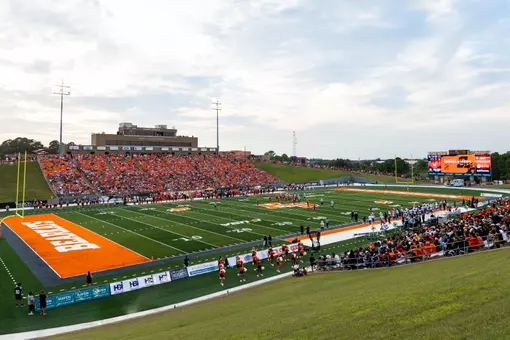
With Sam Houston's move up to the Southland Conference and NCAA Division I Football Championships Subdivision (FCS) play, the Bearkats moved into a new home in 1986. Bearkat Stadium (renamed Elliott T. Bowers Stadium to honor the former university president in 1990) opened on September 13, 1986, with a 23-6 victory over Montana State. The new facility seated more than 12,000 fans.
“Moving into Bowers Stadium and up to FCS was an exciting time,” Bearkat Director of Athletics Bobby Williams said. Williams joined Ron Randleman's coaching staff as an assistant in 1982. “For four years, we recruited based on pictures of the new stadium and a hole in the woods on the hill where it was going to be built. Moving into the facility was new, modern and uplifting. We really appreciated it.”
Bower Stadium continues to see improvements. This fall, a new video scoreboard will sit in the south end zone. With dimensions of 32 feet, 4 inches by 79 feet, 6 inches, the board will be among the largest for an FCS university. The board features a full LED, 15 mm, 480 x 1584 HD video display. It includes the capability for live video, custom animation with full-color graphics.
Two other areas of comparison between Sam Houston's early years and the present that feature stark contrasts are travel and media exposure.
During the first four decades of Bearkat football, Sam Houston's only out-of-state trips were to play teams in Louisiana or Oklahoma. The rides were four to six hours but, with the addition of Sul Ross to the Lone Star Conference in 1948, the most dreaded trip was to Alpine, Texas.
“Sul Ross was definitely the longest trip,” Kyle said. “After World War II, the U.S. Army sold off buses as surplus and that's what we road. We all played a lot of bridge and canasta on those trips.”
Ronnie Choate, a member of the Bearkat teams from 1956 to 1959 and a coach and athletic administrator during the next 40 years, remembers one special trip to Alpine.
“We'd stop at a service station every 200 miles since there was no bathroom on the bus,” Choate said. “Once Dr. Harmon L. Lowman, the school president, came with us and Coach (Paul) Pierce started to drive off without him. He came running out of the station and flagged us down. All the players thought Coach Pierce was going to get in trouble but Dr. Lowman was a good sport about it.”
Sam Houston's first airplane flights came in 1953 for a regular season game versus Tampa in Florida and the Refrigerator Bowl in Evansville, Indiana. The Bearkats also flew to the 1956 Refrigerator Bowl and to Findlay, Minnesota and Augusta, Georgia for the NAIA national semifinals and championship games in 1964.
“There were no jets then,” Choate, who made three of those five trips. “We flew on a DC-3. Both prop engines were so loud, you felt like they were in the plane with you.”
Until the move up to the NCAA level in the 1980s, Sam Houston traveled out of Texas, Louisiana and Oklahoma only seven other times. Even with the squad size increases due to the advent of two-platoon football (different lineups on offense and defense), buses were the primary mode of transportation.
“When I first got to Sam Houston, we traveled in a 55-passenger bus and two vans,” Williams said. “As a young assistant coach, I drove one of the vans. We were coming back from Weatherford, Oklahoma, one Saturday night and had a blowout. When we finally found a place that was open, the only tire they had that would fit was used and had no tread.
“I still swear that tire was more square than it was round. Everybody in the van had to chip in whatever money they had in their pockets to pay for it. Somehow we made it all the way back to Huntsville on that tire.”
Since moving up to FCS play, Sam Houston has flown across the country on regular commercial flights as well as charters. Last season alone, the Bearkats totaled more than 11,000 air miles with trips to Cheney, Washington; Philadelphia; Jacksonville, Alabama and Fargo, North Dakota.
Buses are the norm for games in Texas and the surrounding states, but the vehicles are modern 44-passenger buses with comfortable seats, televisions and wifi.
The first telecast of a college football game matched Fordham and Waynesburg at Ebbets Field in Brooklyn in 1939. Sam Houston's first live TV appearance did not come until 1984 when the Kats played host to Stephen F. Austin at Pritchett Field.
“A cable TV company from the Greater Houston area televised three of our games,” Williams said. “There probably weren't a lot of viewers but we could say we were on live TV. I think the company went out of business during the third telecast.”
More television exposure came with Sam Houston's new affiliation with the Southland Conference as the Bearkats were featured as part of the league's package with Fox Sports Southwest in 16 telecasts from 1989 to 2007. Since then, the Kats have been part of 22 telecasts on the Southland TV regional network.
Sam Houston became the first (and only) Southland team to be paid to televise a home game by a major national television network when ABC-TV gave the University $25,000 to air the Kats' match-up with Alcorn State and quarterback Steve “Air” McNair (later a Super Bowl starter for the Titans). Sam Houston won 48-23 in front of a then record crowd.
The Bearkats' recent success in FCS playoff competition has led to 19 football appearances on the ESPN family of networks in the past four seasons. Sam Houston and Eastern Washington played in ESPN's “Kickoff Classic” last August in the first game of the 2014 college TV schedule.
Perhaps the biggest difference between the early years of Sam Houston football and today is the cost of providing scholarships for the Bearkat student-athletes.
“Coming from Rockdale, a small Class B school, I never really thought about college when I was in high school,” Kyle said. “A teammate of mine and I were invited to come to Sam Houston for a tryout. They bedded us down in the old men's gym and for three days we worked out at Pritchett with the team.
“When the coach offered me a scholarship, I didn't even know what that was. I couldn't afford college, but when he told me I could get room, board and tuition for playing football and get a degree out of it, I thought he'd lost his mind. I said yes. I had found a place to get a college education.”
In the 1950s, the program was limited to 33 scholarships. Players lived for free in the men's gym and ate in the cafeteria. Each got a dollar a day for laundry money.
“Everything that was included in those days wasn't more than $500, but it was a great opportunity to come here, play football and get your degree,” Choate said.
Like everything since the 1950s, costs have continued to rise. Today a full athletic scholarship at Sam Houston is $19,632.
Hundreds of young men and women have taken advantage of the same opportunity in their sports to earn Sam Houston degrees and join the work force in Texas and other states. These student-athletes have achieved on the field, in the class room and the community and brought both regional and national attention to Huntsville and Sam Houston through the program's media exposure.
To insure that this success continues, the athletic department has initiated efforts to increase external revenue sources for scholarships, equipment, facilities improvement and travel expenses.
“In 1998, when I became athletic director, 93 per cent of our funding came from the university and student athletic fees,” Williams said. “That figure now is down to 62 percent with the rest coming from external sources. To see continued improvement and growth of the national prominence the 100th season and beyond, it is crucial that the financial support of our alumni, fans and friends not only continue but increase.”
The 100th season begins September 5 when Sam Houston meets Texas Tech in Lubbock. The Bearkats will play five home games at Bowers Stadium and meet Stephen F. Austin in the 90th “Battle of the Piney Woods” presented by H-E-B on Saturday, Oct. 3, at NRG Stadium in Houston.