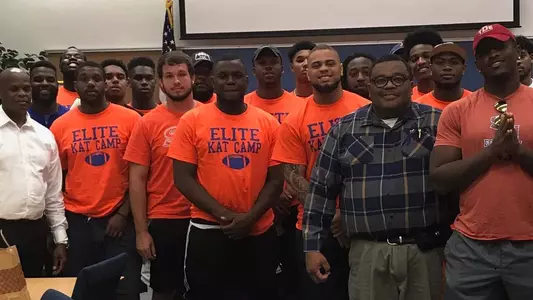
Bearkats get life lessons from local offenders
6/13/2017 2:35:00 PM | Football
HUNTSVILLE – The Sam Houston State Bearkat defensive line is making the most of their summer, recently taking part in the TDCJ Life Decisions Program where they met with offenders who shared their stories in an effort to help educate the student-athletes on the importance and consequences of the choices they make.
Coaches Rodrique Wright and Siddiq Haynes met with Doug Dretke, Executive Director for the Criminal Justice Center's Correctional Management Institute of Texas and Marvin Dunbar, Deputy Director of Texas Department of Criminal Justice's Rehabilitation Programs Division, in hopes of organizing a program for the Bearkat defensive line. The endeavor created was one which was intended to educate the Bearkat student-athletes about life decisions, in addition to understanding the great opportunities that each day presents to them.
This is nothing new for the Bearkats as community service and group bonding have been key initiatives during head coach K.C. Keeler's tenure. Throughout the spring and summer, each position coach does some form of community service with their position group, and according to Haynes, the defensive line coaches wanted to provide a unique experience for their group.
"We wanted to do something different with our guys,” Haynes said. “We always talk about their mindset, and how a good mindset is the key to success on and off the field. By having current offenders come talk to them, it was a great way for them to see firsthand where poor choices can lead you."
Wright said that the idea started due to Sam Houston's strong ties to the prison system through the criminal justice department on campus and that this program was a great way to embrace local resources and utilize it in a positive way. Additionally, several players in attendance currently major in criminal justice.
“The offenders really delivered a humbling message,” Wright said. “They are literally five minutes away, living in a tough situation after making mistakes that they wish they could take back. I think it gave the guys a new life perspective and helped them to understand what they have, how their situation is a good situation and to realize they are one mistake away from being in the same position as those men speaking to them.”
The coaches and players met with two offenders who spoke on the loneliness they faced during their incarceration, their rights that were taken away and the everyday struggles they deal with. Each expressed to the group the importance of staying true to oneself, to never be too afraid to ask for help and seek a and develop a strong support system.
"The guys received it extremely well,” Dunbar said. “This program can be something that we follow up on and build a long-term relationship and help them with challenges they face as collegiate student-athletes.”
“We were very engaged, with a lot of energy, and it had a great message to it,” Kahlil Welsh, a criminal justice major, said. “They taught us that some traditional methods work and some do not. Their biggest message was don't be afraid to reach out for help."
Mark Holmes, Program Director for Cognitive Intervention Pre-Release Program, organized a short presentation for the group to explain how they could work through challenging situations they face as student-athletes. Holmes said the intention was to help the players use mature coping mechanisms and acknowledged that doing so can be difficult in the heat of the moment. But he also recognized that with proper education, they would be more prepared to make more mature life decisions.
"Hearing from the offenders who have faced tough life challenges makes you think twice about your choices in life,” PJ Hall said after the program's conclusion. “Being a criminal justice major myself, I've learned about the justice system and where it can lead if we make the wrong decisions. But having the inmates share their story directly adds more depth to it.”